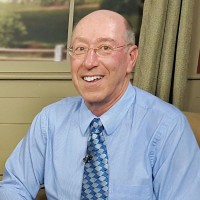
On this week’s podcast, Dan and Ellen talk with Jeff Jacoby, longtime columnist for The Boston Globe opinion pages. Jeff also writes the weekly “Arguable” newsletter.
Jeff holds degrees from George Washington University and from Boston University Law School, and before entering journalism, he briefly practiced law. He was also an assistant to John Silber, the prickly president of Boston University.
Prompted by a column Jeff wrote in June, and spurred on by the impending midterm elections, the podcast features a free-form discussion of whether newspaper editorial pages should endorse candidates in presidential races. It’s a hot topic these days — this piece by Joshua Benton in Nieman Lab is one of just several to note that endorsements are on the wane.
Dan has a Quick Take on a big story out of Woburn, a suburb north of Boston. Woburn has an independent newspaper and is covered by the Globe and other outlets. But this story wasn’t broken by any of the usual suspects. Ellen’s Quick Take is on an opinion column in The Washington Post by Perry Bacon Jr., who calls for $10 billion in government funding to support a news outlet in every congressional district in the country. As you’ll hear, Ellen and Dan both have some problems with Bacon’s proposal.
Congressman David Cicilline. Photo (cc) 2018 by the Brookings Institution.
On our latest podcast, Dan and Ellen talk with U.S. Rep. David Cicilline, who represents the First District of Rhode Island in Congress. Cicilline, who is a Democrat, is part of a bipartisan group of U.S. representatives and senators sponsoring the Journalism Competition and Preservation Act. Co-sponsors include Democratic Sen. Amy Klobuchar from Minnesota; Republican Sen. John Kennedy from Louisiana; Republican Rep. Ken Buck from Colorado; and Senate and House Judiciary Committee chairs Dick Durbin, an Illinois Democrat, and Jerrold Nadler, a New York Democrat.
The JCPA would remove legal obstacles to news organizations’ ability to negotiate collectively and secure fair terms from gatekeeper platforms that proponents say use news content without paying for it. Critics counter that it’s more complicated than that. The legislation also allows news publishers to demand arbitration if they reach an impasse in those negotiations.
Ellen has a Quick Take on new research being done by the Institute for Nonprofit News. The INN just released 2022 fact sheets on three types of nonprofit newsrooms: local news, state and regional news, and national and global news. While each group shares some similarities, INN found that geography matters in terms of revenue models and audience development.
Dan takes a few more whacks at Gannett because newsrooms are being hit with unpaid furloughs, buyouts, a freeze on their pension benefits and more.
On this week’s podcast, Dan and Ellen talk with David Dahl, editor of The Maine Monitor. David was most recently a deputy managing editor at The Boston Globe. Among his jobs at the Globe: directing hyperlocal Your Town coverage at Boston.com, an initiative that ended not long after John Henry bought the paper in 2013. The pull of Maine was strong, however. He and his wife, Kathy, have a home in Friendship, Maine. When he decided that he was ready to turn the page, he looked Down East.
Dan has a Quick Take on Bulletin, a feature developed by Facebook to compete with Substack that included local journalism produced by people of color. Sarah Scire has the scoop: Bulletin is shutting down. Ellen has a Quick Take is on a new kind of media audit by the Alliance for Audited Media, which has been verifying newspaper circulation for 108 years. The organization says it’s branching out, to audit standards of ethics in journalism. Ellen asks: Why?
Dakotah Kennedy, a graduate student at Northeastern University (who is not related to Dan), contributes on-the-ground interviews from attendees at the recent Radically Rural conference in New Hampshire. Our recent podcast with Terry Williams, creator of the conference, can be found here.
The Bedford Citizen, one of the first and most successful hyperlocal websites in the Boston suburbs, has hired its second managing editor. Wayne Braverman, a veteran journalist who most recently worked for Gannett, will succeed Julie McCay Turner, who announced her retirement earlier this year.
Turner and two other women founded the Citizen 10 years ago. Originally an all-volunteer project, the outlet slowly morphed into a professional operation that was able to pay Turner and a part-time staff reporter, Mike Rosenberg. The nonprofit continues to be run by a volunteer board of directors. Braverman’s hiring marks the first time that the Citizen will be run by someone who wasn’t one of the founders and thus represents a rather momentous transition. Turner will remain involved in the Citizen as well.
According to Braverman’s LinkedIn profile, he was editor of Gannett’s Boston Homes publication until about two weeks ago, when Gannett closed the publication. He worked as the internship coordinator for GateHouse Media, Gannett’s predecessor company, from 2002-’16 and has also worked as a radio host and public-speaking instructor. He earned a master’s degree in journalism from Boston University and a bachelor’s degree in political science from UMass Lowell.
The Citizen is among the projects that Ellen and I are writing about in “What Works,” our book-in-progress about the future of local news.
What follows is a press release from Teri Morrow, the Citizen’s executive director:
I want you to be among the first to know: Wayne Braverman — award-winning journalist and Bedford resident — joins The Bedford Citizenas Managing Editor this week.
Wayne brings both reporting and editorial experience as well as considerable enthusiasm for Bedford to the role.
During his career, Wayne has served as a reporter, senior editor, and managing editor in the Boston area. He’s worked for print and online publications. And he has experience expanding the scope of local news.
As you’ll read this week, Wayne says The Bedford Citizen is “considered by many professional journalists to be the model of how people can come together to create a new media outlet to provide residents with effective coverage of their community.”
I hope you are patting yourself on the back! That’s because you are one of the reasons journalists like Wayne consider The Citizen as a model of local journalism! Thank you for standing up for local news.
Throughout the interview process, Wayne shared that he is “ready to carry on the … mission of The Bedford Citizen.” And that he will “work with our staff and the people of Bedford to take [The Citizen] to its next evolutionary level.”
I hope you are as excited as I am to see what happens in the coming months and years with Wayne in the Managing Editor role. Should you see him around town, please share your thoughts and ideas about The Citizen.
Anne Galloway speaks at VTDigger’s 10th anniversary celebration in 2019. Photo by Glenn Russell, courtesy of VTDigger.
On this week’s podcast, Dan and Ellen talk with Anne Galloway, the founder and editor-at-large of VTDigger in Vermont. Like many journalists, she was laid off in 2009 from her job as Sunday editor of the Rutland Herald and The Barre-Montpelier Times Argus.
VTDigger, which is a nonprofit, started with a $16,000 budget with no employees. As Galloway put it in a recent letter to readers, it has grown beyond her wildest dreams. It’s the largest newsroom in Vermont, with dozens of employees and more than 550,000 monthly readers. Galloway not only built the organization, she also wrote notable investigative pieces. Among other issues, she broke open a fraudulent scheme that involve developers at Jay Peak. Dan visited Galloway and wrote about the newsroom in his 2018 book “The Return of the Moguls.”
Earlier this year Galloway stepped aside from her management position in order to concentrate on investigative reporting.
Ellen has a quick take on a study about the state of U.S. democracy from the Carnegie Endowment for International Peace. The study says it’s critical to fight disinformation, and advocates rebuilding trusted local news sources.
Dan reports on a promising merger between public radio station KERA and the Denton Record-Chronicle, a daily newspaper that covers the suburbs north of Dallas. This move was facilitated by the National Trust for Local News, which raises money and connects legacy newspaper owners with possible buyers in order to keep them from either shutting down or falling into the hands of corporate chain owners. Our podcast with Elizabeth Hansen Shapiro, CEO and co-founder of the trust, can be found here.