Our What Works: The Future of Local News program at Northeastern University is cited in a new report from the Center for Community News at the University of Vermont. The report, “University Resources That Support Local Media Ecosystems: An Institutional Analysis of Higher-Ed Potential,” was written by Corey Hutchins of Colorado College.
Hutchins’ report mentions What Works as one of four university-based projects that are benefiting not just our own state of Massachusetts but also beyond our borders, as our frequently updated website and twice-monthly podcast “supports independent community news throughout the country.” Hutchins writes:
In recent decades, as the local news industry has contracted, students studying on our nation’s campuses have increasingly filled gaps in local reporting while in college. Now, across the country, more and more higher-ed academic programs are working to support their state’s media ecosystems in vast and various ways beyond student reporting.
What Works also maintains a database of independent local news outlets in Massachusetts, sponsors webinars and conferences for local news leaders, and engages in public advocacy.
In addition to What Works, our School of Journalism publishes The Scope, a grant-supported digital outlet that covers social-justice issues in the Boston area. And, of course, Northeastern has long been known for its cooperative education program, which places students in paid jobs, including media organizations and other communications-related fields.
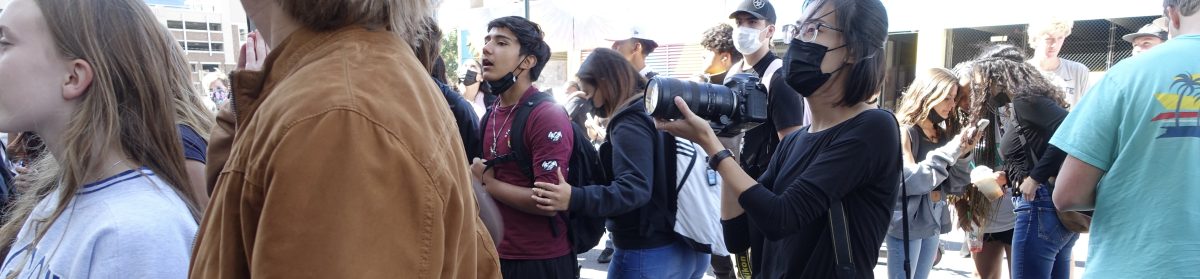
Protesters in Raleigh, N.C. Photo (cc) 2026 by Laura Leslie / NC Newsline.
By Dan Kennedy
All news is local. Following the deadly U.S. raid to pluck President Nicolás Maduro and his wife, Cilia Flores, out of Venezuela, local news organizations reported on the reaction in their communities. This morning I’m taking a look at how three of the outlets that we profile in our book, “What Works in Community News,” are handling the news.
Jose Lara, a Venezuelan expat living in West Haven, Connecticut, told Breen he was hopeful that Maduro’s arrest would lead to better days for his home country. “I’m feeling excited,” Lara said at a gathering outside New Haven City Hall. Breen writes:
Like Lara, many who showed up on Saturday night were optimistic that this time is different.
“Excitement, first and foremost,” Laura Almeyda said when asked how she is feeling today. Also, “confusion. Uncertainty. But hope. We’re faithful and joyful. This is a huge step towards change, hopefully a positive one.”
Breen observes, though, that others, such as U.S. Rep. Rosa DeLauro, D-Conn., are warning that Trump’s action was “a fundamental violation of the Constitution” that could lead to “endless conflict.” And he links to another indy digital outlet in Connecticut, CT News Junkie, where Karla Ciaglo reports on the (mostly) negative reaction from Democratic officials and left-leaning activist groups.
As with the New Haven Independent, The Daily Memphian — supplemented with coverage by The Associated Press — focuses on the Venezuelan diaspora community in Memphis, Tennessee. Here’s part of the Memphian story:
“We have been dreaming of these days for so long. We have been hopeful of a day when we see [these leaders] out of the country and really democracy back in our country,” said Daniel Bastardo Blanco, who works in communications in Memphis. “We remain incredibly hopeful that freedom is about to restart in our country.”
But Venezuelan natives living in Memphis also said that their euphoria was also mixed with fear for friends and relatives still living in the South American country, where some citizens were killed in the strikes, as well as tremendous uncertainty about what happens next.
“It was a little bit of a shock,” said Pedro Velasquez, whose family runs nonprofit medical clinics in both Memphis and Venezuela. “As I read about how it was executed, and that there weren’t as many civilian casualties, that it was more localized and over in 20-30 minutes, it sort of made me breathe a little easier.”
Jackson leads with Andrew Josefchak of the Minnesota Peace Action Coalition and a left-wing supporter of the Maduro government, who joined with more than 200 others to protest Trump’s action on Satuday. “The peace movement in this country, in Minneapolis at least, wasn’t going to let that [military action] go by without organizing an emergency demonstration against it to show that people in the U.S. don’t want this,” Josefchak was quoted as saying. “They don’t want war.”
The Strib also quotes Democratic opponents of Trump’s action like U.S. Sen. Amy Klobuchar and Republican supporters like U.S. Rep. Tom Emmer. And we hear from a Venezuelan expat who supports the raid despite concerns about her mother’s safety:
Soleil Ramirez watched footage of explosions across Caracas moments after the strike began, worrying for her mother, who lives near a military base.
Ramirez, chef and owner of the Crasqui restaurant in St. Paul, said her mother is fine — and the military operation was reason to celebrate.
“Let us celebrate this victory because we haven’t been celebrating anything in the last 26 years,” she said.
A note on the photo:NC Newsline, which covers North Carolina, is part of States Newsroom, a network of 50 nonprofit news outlets covering politics and public policy. Its journalism is available for republication under a Creative Commons license. We recently hosted publisher and CEO Chris Fitzsimon on our “What Works” podcast.