Could public radio help solve the local news crisis? Perhaps. But first we have to determine what we mean by local news, and whether the folks who bring you national programs such as “All Things Considered” and “Morning Edition” are suited to that mission.
In late January, Thomas Patterson, the Bradlee Professor of Government and the Press at the Harvard Kennedy School, published a “discussion paper” exploring that very question. The purpose of discussion papers, according to the introduction, is “to elicit feedback and to encourage debate.” Consider this my small contribution. (Patterson, I should disclose, was acting director of Kennedy School’s Shorenstein Center during my 2016 fellowship there and provided me with valuable advice for my 2018 book “The Return of the Moguls.”)
At the outset, Patterson writes that he seeks to answer two questions:
“Do local public radio stations have the capacity to provide reasonably comprehensive news coverage of the communities they serve? Do they have the news staff needed to meet that requirement? And if not, what level of investment could put them in that position?
“Do local public radio stations have the capacity to reach enough members of their local community to make a substantial contribution to its information needs? And if not, what would be needed to substantially expand their audience reach?”
On the new “What Works” podcast, Ellen Clegg and I talk with Greg Moore, former managing editor at The Boston Globe and longtime editor of The Denver Post. During his 14 years at the Post, the paper won four consecutive Pulitzer Prizes. He’s led coverage of major stories, including the Aurora movie theater shooting in Colorado and the case of Charles Stuart in Boston. Greg is now editor-in-chief of The Expert Press, which helps connect specialists with media. He’s still in Denver.
As one of the most senior Black journalists in the country, Greg has been at the forefront of advocating for more diversity in the media and for a new path forward for local and regional news. In fact, Greg resigned his position at The Denver Post in 2016 after he decided he couldn’t tolerate any more cuts to his newsroom at the hands of the Post’s hedge-fund owner, Alden Global Capital. As he put it in an essay for the Pulitzer Prize board, of which he is the former chair:
Local journalism is where accountability journalism matters most. It is focused on how dollars are spent and how priorities are set on the local level. It is often that base level reporting that becomes the seed corn for bigger national stories with datelines from the heartland and the tiniest suburbs.
In the Quick Takes portion of the podcast, Dan has some bad news: people don’t like us. There’s been yet another survey showing that public trust in the news media is at an all-time low. But there are some problems with the survey, as there usually are — and those problems underline why the trust issue isn’t quite the steaming pile of toxic waste that it might seem, especially for local news.
Ellen has some good news for folks in Akron, Ohio. A local news startup called the Akron Signal has launched with a $5 million grant from the Knight Foundation.
Back before GateHouse Media morphed into Gannett in 2019 and assumed its corporate identity, I believed the company was in it for the long haul. Don’t get me wrong — GateHouse was always obsessed with cost-cutting and was a fairly awful steward of the papers it acquired. But its executives seemed to have convinced themselves that ugly was the only way to win, and that winning meant surviving.
No longer. I couldn’t possibly tell you what Gannett is up to anymore other than squeezing its properties for every last drop of revenue. On Thursday, the company released its latest financial results. They were terrible for journalists and the communities they serve. For investors, though, they were pretty good.
Don Seiffert reports in the Boston Business Journal that Gannett slashed the number of journalists at its 200 or so newspapers (including the flagship USA Today) by 20% over the past year — no surprise to those of us who were following those cuts throughout the year. Seiffert paged through the annual report and found that Gannett employed 3,900 journalists at the end of 2022 (3,300 in the U.S. and 600 at a U.K.-based subsidiary), down from 4,846 a year earlier. At the same time, though, the company had achieved profitability, which sent the stock price soaring by 22%
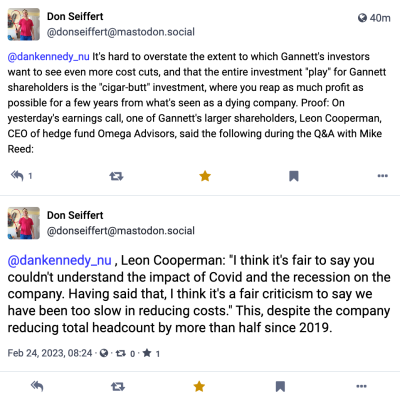
Incredibly, some of those investors think Gannett has been too slow to cut. For instance, Seiffert said on Mastodon that, during Thursday’s earnings call, Leon Cooperman, CEO of the hedge fund Omega Advisors, which is among Gannett’s larger investors, told Gannett chair Michael Reed, the $7.7 million man: “I think it’s fair to say you couldn’t understand the impact of Covid and the recession on the company. Having said that, I think it’s a fair criticism to say we have been too slow in reducing costs.” As Seiffert noted: “This, despite the company reducing total headcount by more than half since 2019.”
So what’s ahead? You will not be surprised to learn that CFO Doug Horne told investors that Gannett’s going big-time into artificial intelligence to perform some of the work that used to be done by journalists. Just feed the audio from the planning board meeting into ChatGPT and see what happens, I suppose.
Over at Poynter Online, Angela Fu reports that Reed is wicked psyched about 2023, writing:
Reed said the company is entering 2023 with “a lot of optimism.” Inflation seems to have peaked, he said, and newsprint and distribution costs have largely stabilized. In response to a shareholder question about a possible recession, Reed said the company had not seen anything in the first quarter to indicate the country was moving in that direction.
Unless it proves otherwise, though, Gannett should be regarded as nothing but a financial play at this point. The best thing it could do is offload its community papers to local owners who actually care about journalism, as it has done with a few weeklies Central Massachusetts as well as the Inquirer and Mirror of Nantucket, which I wrote about recently in an op-ed piece for The Boston Globe. Gannett has sold some of its papers nationally as well.
In many other cases, vibrant startups from The Provincetown Independent to several projects in the Boston suburbs are competing with vestigial Gannett papers, but more are needed. As Steven Waldman, president of the Rebuild Local News Coalition, has proposed, we need tax incentives aimed at persuading Gannett and other chains to get out of town — and to give committed local ownership a chance to revive grassroots news coverage.
As I wrote last week, the matter of how the Alliance for Audited Media counts paid digital subscriptions is something that has confused me for a long time. In September 2021, I sent an email to Erin Boudreau, AAM’s senior marketing manager in which I asked her some of the questions that I asked here. She responded with links to two fact sheets (here and here), neither of which struck me as especially helpful.
Because of that, I wrote last week’s item without checking in with AAM again. I immediately heard from Boudreau, but still without the information I was looking for. Now, I have no reason to believe that Boudreau was being deliberately obtuse, and I’m also aware that AAM is at the mercy of the newspapers that pay them. AAM’s job is to be accurate and rigorous, but they’re dependent on the data that publishers provide.
In any case, I decided to try again with Boudreau, asking her a series of specific questions expanding on what I asked her a year and a half ago. I would describe her answers as helpful but still confusing. Probably the most significant piece of information she told me is that even though newspapers don’t charge subscribers separately for digital replica (the e-paper) and nonreplica (the website and apps), they report those numbers to AAM separately based on an internal count by the publishers. There is also some double-counting going on — a print subscriber who also accesses digital may be included as a digital subscriber as well.
I continue to believe that the two most important numbers for determining the health of a newspaper is, first, the number of paid digital-only subscribers and, second the number of paid print subscribers. AAM is very good at providing the second number; the first remains elusive. As you’ll see, I mainly used The Boston Globe for my examples but also cited the Burlington Free Press, Gannett’s Vermont-based daily. In any case, here is our full exchange. I’ve lightly edited my questions, but her answers are as they provided them to me.
Q: How is it possible for newspapers to report separate numbers to you for replica and nonreplica when they don’t sell digital subscriptons that way? This is a question I’ve asked you before. Let’s use The Boston Globe as an example. According to the most current report that the Globe filed with AAM, its nonreplica digital circulation is 254,877 and its replica circulation is 26,666. But the Globe (following the practice of most newspapers) doesn’t sell digital subscriptions that way. One price gets you the website, which includes an e-paper option as well as a separate e-paper app for mobile. I can understand why advertisers would like to know what the Globe’s replica circulation is, but how can the Globe determine that when it doesn’t offer readers a separate replica subscription?
A: Our rules are structured to count circulation if a publisher sells print and digital access or digital-only access.
For print + digital subscriptions:
If the subscriber gets a print copy daily, the print copy counts as a paid circulation unit.
If the subscriber also accesses digital, one digital copy could count as a paid circ unit as well.
If they access a replica edition, they can claim a replica.
If they access an app or website, they can claim a nonreplica.
If they access multiple digital channels, the publisher can choose if they want to claim one replica or nonreplica edition.
For digital-only subscriptions:
Qualification is based on payment, not access.
Circulation can be counted either as digital replica or nonreplica.
Only one digital unit can be claimed as paid per day during the subscription term, regardless of the number of times the consumer accessed the digital edition or across multiple digital platforms during the day.
Q: You’ve told me: “Digital reporting has largely been tied to the print subscription. On days when there is a print edition, the user must access the digital edition for it to count. If there is no print edition on a given day, the digital edition sold as part of the subscription offer qualifies as paid circulation.” But that is not the case with the Globe, which continues to offer seven-day print.
A: With seven-day print, the publisher can also count a replica or nonreplica edition for a print subscriber if that subscriber accessed one of those digital editions.
Q: What is included in the Globe’s nonreplica digital subscription circulation of 254,877 given that it’s higher than the Globe’s own number of 240,000 for digital-only subscribers? What is being included in the higher number that’s not included in the lower number?
A: While we can only speak to data included on AAM statements, a digital circulation total may also include print subscribers who have accessed a digital edition, not solely digital-only subscribers.
Q: A former high-ranking newspaper editor told me that a newspaper’s total digital circulation can be determined by adding together replica and nonreplica. Was he right about that?
A: Yes, if you are looking for total digital circulation.
Q: To go back to the Burlington Free Press for a moment, when you add together its replica and nonreplica numbers, the total still comes out to half or less of the total digital circulation that is included in Gannett’s internal report. Do you have any insight into why that would be?
A: The circulation data included in AAM statements comes from the publisher. We cannot speak to what’s included on non-AAM reports.
In reporting on the newspaper business, there are few matters more obscure or maddening than determining paid digital circulation. My example for this morning is the Burlington Free Press, a Gannett-owned daily that, I wrote recently, will soon be printed in either Auburn, Massachusetts, or Providence, hours away from its home base in northern Vermont.
The change is the result of the giant newspaper chain’s decision to shut its printing plant in Portsmouth, New Hampshire, which will affect several other papers as well. Gannett’s standard defense of moves like this is that they’re shifting to digital, so print doesn’t matter that much. But as I observed at the time, the Free Press sells more than twice as many print papers as it does digital subscriptions.
My item prompted someone to send me a “confidential and internal” Gannett circulation report.
I’ll get to that. But first, let me explain what you’ll find if you look at reports filed with the Alliance for Audited Media, the organization to which newspaper publishers report circulation figures and which advertisers use to determine whether they’re getting a fair deal or not.
In order to make an apples-to-apples comparison, I’m going to use the Free Press’ AAM figures for the six-month period ending March 31, 2021, because that’s the last time they provided two different types of digital numbers. According to that report, the Free Press’ circulation was as follows:
Print: An average of 7,996 on weekdays; 10,295 on Sundays
Digital replica: 2,823 on weekdays; 1,407 on Sundays
Digital nonreplica: 1,407 on weekdays; 1,161 on Sundays
If you add the two types of digital together, which I’m told is a valid step to take, you end up with paid weekday circulation of 4,230, or just a little more than half of print circulation. Sunday digital is 2,568 — barely a quarter of Sunday print.
Now, what are these two types of digital? I am told by a highly knowledgeable source that they are what you’d imagine they are. Replica is an exact image of the paper, often called the e-paper. Nonreplica is the website and similar products, such mobile apps. But there is a huge problem with making that distinction: No newspaper that I’m aware of — certainly not the Burlington Free Press — charges separately for replica and nonreplica access.
The Free Press’ digital subscription offer
For instance, if you sign up for “unlimited digital access” to the Free Press you get, among other things, “full access to subscriber-only content on your desktop, tablet and mobile device” and “the eNewspaper, a digital replica of the print edition.” There is no separate sign-up for the e-paper; instead, everything is included in a digital subscription.
And lest you think this is a Gannett thing, the independently owned Boston Globe also reports separate numbers for replica and nonreplica. If you’re a Globe subscriber, as I am, then you know that a digital subscription gives you access to the website, which already includes the e-paper. There’s also a separate e-paper app available for mobile. So with the Globe, as well as with Gannett, it’s a mystery as to how they can claim to have separate paid digital numbers for replica and nonreplica, or for weekdays versus Sundays. And I do mean a mystery: I have asked a number of people over the past few years, including the AAM, and I’ve been unable to get a clear answer.
Now to get to that internal Gannett report: my informant wanted me to know that I was under-counting the Free Press’ paid digital circulation by quite a bit. And sure enough, the internal report showed that the Free Press’ paid digital in 2021 was 8,524 — double the combined replica-plus-nonreplica weekday number it had reported to the AAM and more than its weekday print circulation. By mid-2022 that had risen to 8,902. Unlike the AAM report, the internal figures show no separate breakdown for replica and nonreplica and no separate numbers for Sunday. Which makes sense, because that’s not the way digital subscriptions are sold. As I said, one price gets you everything — website, apps and e-paper, weekdays and Sundays.
Now, weirdly enough, the Globe’s reports to the AAM actually show higher digital circulation than what it has publicly announced. For instance, in February 2022, then-editor Brian McGrory told his staff that the digital-only paid circulation had reached 235,000 (up to 240,000 as of last fall). Yet according to AAM figures, the Globe’s paid weekday digital for the six-month period ending March 31, 2022, averaged 262,576, of which about 12,000 was replica. The Sunday digital figures were about 15,000 higher overall; again, about 12,000 was replica.
All of this is a shame because, before the rise of paid digital circulation, the AAM — formerly known as the Audit Bureau of Circulations — was the gold standard when it came to counting print. Digital has been a different story. Back in 2013, I reported that the AAM was double- and even triple-counting digital subscriptions depending on how many devices a particular subscriber was using, which was just nuts. (I also see that I quoted “Globe spokeswoman Ellen Clegg,” later the paper’s editorial page editor and now my research partner, co-author and podcast cohost.) I don’t think the AAM reports are that far off these days. But the Burlington Free Press and The Boston Globe show that whatever problems the AAM was having 10 years ago have not been fully resolved.
Paid digital subscriptions are now the standard method by which most newspapers measure their circulation. Print is not an afterthought, but it’s a lot less important than it used to be, and it continues to decline. What’s needed is for the newspaper business and the AAM to work together and come up with a standard method for measuring paid digital.
Correction: An earlier version of this post stated that the Free Press would be printed in either Worcester or Providence. In fact, the Gannett plant in question is located in Auburn, a suburb of Worcester.
On the latest “What Works” podcast, Ellen and Dan talk with Victor Pickard, a professor of media policy and political economy at the Annenberg School for Communication at the University of Pennsylvania. Before he was at Penn, he taught media studies at NYU. He is the author of several books, including “Democracy without Journalism,” which Dan reviewed a couple of years ago for GBH News.
Pickard has contributed to the debate about the local news crisis in many different settings. He worked on media policy in Washington at the New America Foundation, and he served as a policy fellow for former U.S. Congresswoman Diane Watson.
Dan has a Quick Take on a legislative proposal that’s now being considered in Massachusetts, inspired by a federal bill that died in the last session. The proposal would provide tax credits to anyone who subscribes or donates to a local news organization.
Ellen’s Quick Take is on something close to home. She’s joined a group of Brookline residents who are launching an independent nonprofit news site called Brookline.News. The steering committee has been raising funds, and is recruiting for a founding editor-in-chief.
The Berkshire Eagle of Pittsfield is overcoming the devastating cuts imposed by hedge-fund ownership. 1899 map via Snapshots of the Past.
By Dan Kennedy
By now it is widely understood that local news is in crisis. The United States has lost a fourth of its newspapers since 2005, and the loss has led to such ills as lower voter turnout in local elections, more political corruption, and the rise of ideologically driven “pink slime” websites that are designed to look like legitimate sources of community journalism.
Even in the face of this decline, though, hundreds of local news projects have been launched in recent years, from Denver, where The Colorado Sun was launched by 10 journalists who’d left The Denver Post in the face of devastating cuts, to MLK50, which focuses on social justice issues in Memphis. Some are nonprofit; some are for-profit. Most are new digital outlets; some are legacy newspapers. All of them are independent alternatives to the corporate chains that are stripping newsrooms and bleeding revenues in order to enrich their owners and pay down debt.
There is no substitute for journalism. For-profit legacy newspapers may no longer muster enough reporting capacity to cover their communities — especially if they’re owned by a corporate chain or a hedge fund. But independent journalism with reporters, editors and ethical standards are fundamental to providing the public with the news and information it needs to govern itself in a democracy.
Today we are seeing an explosion of independent local news outlets, mostly digital, mostly nonprofit. It’s happening in the Boston area and across the country. Yet a different kind of vision, stretching back to the earliest days of the web, persists: that members of the public can take charge of at least some of their own information needs. We used to call these people citizen journalists, and it became fashionable to sneer when that vision fell short of its most idealistic expectations. Yet it persists in some quarters and — harnessed properly — could still prove useful to grassroots democracy and storytelling.
Last week a report called “The Roadmap for Local News: An Emergent Approach to Meeting Civic Information Needs” was released by three respected media thinkers — Elizabeth Green of Chalkbeat, Darryl Holliday of City Bureau and Mike Rispoli of Free Press. Based on interviews with 51 thought leaders in local news, the report calls for reorienting ourselves from journalism to civic information in solving the local news crisis. They write:
This new ecosystem looks different from what it will replace: while the commercial market rewarded information monopolies, what is emerging now are pluralistic networks in which information is fluid, services are shared, and media is made in cooperation with the people it seeks to serve.
There’s a lot of language like that in the 28-page report, and it can be difficult in places to figure out exactly what they have in mind. But they do offer some examples that help make their vision come into focus. Among them: A text-messaging service, backed by reporting, to help subscribers keep up with school board meetings in Indianapolis; a digital memorial to those who died from COVID-19, along with a way for local residents to contribute more stories; and community events that bring residents and journalists together in order to identify coverage priorities — classic 1990s-style public journalism of the sort espoused by Jay Rosen, I might note. In another section they write:
Civic media practitioners are united by a vision of a world in which people everywhere are equipped to improve their communities through abundant access to high-quality information, on urgent health and safety emergencies, the environment, the people and processes of local government, and daily social services like healthcare, education, and transportation. In this vision, the community librarian facilitating conversations around authoritative, trusted digital news is as celebrated as the dogged reporter pursuing a scoop.
Now, I admire and respect librarians as much as the next person (my wife is one), but when it comes to holding government and other powerful institutions to account, I would respectfully suggest that we need more digging and less facilitating. But maybe we can have both.
Unfortunately, I think the report’s authors really run into trouble when they start telling us what this is all going to cost. They observe that public support for local news is slowly ticking up through direct governmental funding in New Jersey and California and as well as government-provided advertising in places like New York City and Chicago.
But they’re looking for more — a lot more — on the theory that market forces and philanthropy can’t come close to providing what’s needed. On the low end, they say $1 billion a year is needed; on the high end, they suggest $10 billion in order to employ at least 100 reporters per congressional district, as suggested by Washington Post columnist Perry Bacon Jr. a few months ago. The political environment is such that a Democratic Congress couldn’t even approve modest measures to let the news business negotiate for compensation from Google and Facebook or tax credits aimed at shoring up community journalism. And the Democrats, in case you haven’t noticed, are no longer in control. Green, Holliday and Rispoli write:
Civic information is a public good that market forces and philanthropy alone cannot support at the scale needed to enable healthy information ecosystems across the country. And for all the good produced by our public broadcasting system, it has also been chronically underfunded especially in comparison to other democratic countries.
The underfunding is certainly real enough. Victor Pickard, in his 2020 book “Democracy without Journalism,” observes that the entire budget for public broadcasting in the U.S. is less than is allocated to the Pentagon’s public-relations office. But the U.S. isn’t Western Europe, where government-funded news is taken for granted and where — we should keep in mind — there is no First Amendment to provide independent journalism with the protections that it enjoys here.
Thus it seems unlikely that the vision laid out in “The Roadmap for Local News” will come to pass. And despite a number of references to the importance of “editorial independence,” some of the ideas in the report strike me as at least a theoretical threat to journalism’s traditional watchdog role. Libraries, after all, are an arm of government — and are under attack from the political right. Local access cable television, which also gets a shoutout, is under the government’s thumb as well. Don’t get me wrong — local access is a wonderful, underutilized asset in every community. But it’s really not in a position to lead the charge on corruption in the mayor’s office.
The agenda in “The Roadmap for Local News” is worth following through on, and would result in better informed communities and greater public participation in civic life. These are worthy goals. But we need journalism, too. I would go so far as to say we need what we might refer to as traditional journalism, even if our reporting methods and the ways in which we distribute our work have changed. Moreover, the money for doing that is not going to come from the government — and shouldn’t, except in a few indirect ways that don’t threaten our independence.
Massachusetts Statehouse. Photo (cc) 1996 by Daderot.
By Dan Kennedy
Now that federal efforts to provide assistance to local news have fallen short, we may see more activity at the state level. One such effort is a bill filed in the Massachusetts Legislature that would provide tax credits to people who subscribe to a “local community newspaper,” whether in print or online. Boston Globe reporter Dana Gerber has the details (and quotes me).
The bill was filed last month by Rep. Jeffrey Rosario Turco, D-Revere. The legislation, H.D.1518, is similar to one of the three tax credits in the federal Local Journalism Sustainability Act — it provides a tax credit for subscribers of up to $250 a year. As I told Gerber, this may prove to be symbolic given that state income taxes are lower than federal taxes. Still, it would focus attention on the importance of local news, which is not a bad thing.
The devil, as always, is in the details. According to the bill, an eligible newspaper or website would have to provide “original content derived from primary sources and relating to news and current events,” serve “the needs of a regional or local community,” and employ “at least 1 local news journalist who resides in such regional or local community.”
That last requirement could prove to be a sticking point. Low-paid community journalists can’t be expected to live in an affluent community where the cost of housing is sky-high. That was as much of an issue decades ago as it is today. Maybe “regional or local” means that a reporter who covers, say, Concord could live in Lowell; I hope so.
Another challenge is that local news is increasingly being provided by nonprofit news organizations as the Gannett newspaper chain closes weekly newspapers and cuts back on community coverage. Most nonprofits offer their news for free, and donations to nonprofits are already tax-exempt.
It’s also hard not to notice that Turco is proposing his legislation in something of a vacuum, as the state commission approved two years ago to study the local news crisis in Massachusetts has yet to get off the ground. I had a hand in drafting the bill that created the commission would be a member. Maybe 2023 will be the year that there’s some movement on that front.



 Because of that, I wrote last week’s item without checking in with AAM again. I immediately heard from Boudreau, but still without the information I was looking for. Now, I have no reason to believe that Boudreau was being deliberately obtuse, and I’m also aware that AAM is at the mercy of the newspapers that pay them. AAM’s job is to be accurate and rigorous, but they’re dependent on the data that publishers provide.


